Inherited Retina Diseases (IRD)
Inherited retinal diseases (IRDs) cause vision loss due to genetic mutations in the retina and can occur across multiple family generations.
Examples of IRDs
Retinitis Pigmentosa
Retinitis Pigmentosa (RP) is a group of eye diseases, typically the result of an inherited genetic abnormality, that causes vision loss by damaging the retina. RP is characterized by the gradual loss of peripheral and night vision. RP affects about 1 in 4,000 people worldwide. Approximately 100,000 to 200,000 people in the U.S. have RP.
Leber Congenital Amaurosis (LCA)
Considered by some experts to a severe early onset form of RP, Leber Congenital Amaurosis (LCA) is an inherited retinal disease that causes severely impaired vision or blindness at birth. LCA is caused by the degeneration of photoreceptors in the retina. LCA is estimated to affect about one in 80,000 people.
Stargardt Disease
Stargardt disease is a severe hereditary form of macular degeneration that begins in late childhood and leads rapidly to legal blindness. It is inherited as an autosomal recessive trait, and it affects approximately one in 10,000 children. Stargardt disease can be identified by multiple yellow spots (lipofuscin) in and under the macula and is characterized by the loss of central vision, hindering activities that require fine visual discrimination such as reading, recognizing faces, watching TV, and driving a car.
Juvenile X-Linked Retinoschisis (XLRS)
X-linked retinoschisis (XLRS) is an inherited eye disease that occurs almost exclusively in males and causes vision loss due to the splitting of retinal layers. Typically diagnosed in early childhood, one of the first signs of XLRS is the loss of visual acuity that is not correctable. Approximately 35,000 people in the U.S. and Europe have XRLS.
Additional Research
Achromatopsia
Bardet-Biedl Syndrome
Best Disease
Blue Cone Monochromacy
Choroideremia
Cone Dystrophy
Cone-Rod Dystrophy
Congenital Stationary Night Blindness
Enhance S-Cone Syndrome
North Carolina Macular Dystrophy
Oguchi Disease
Pattern Dystrophy
Sorsby Dystrophy
Usher Syndrome
Genetics
- An estimated 20% of AMD patients have at least one first-degree relative with the condition.
- Up to 70% of AMD risk is attributable to a genetic family trait.
- The risk of developing AMD is three times greater in people who have a family member with the disease than those without a first-degree relative with AMD.
Prevention
AMD is a generational eye disease that affects central vision by damaging the macula. It is the leading cause of vision loss for those age 50 and above. The biggest risk factor for AMD is age. More than 18 million people in the United States have AMD.
Symptoms include:
- Distorted vision
- Difficulty reading and driving
- Seeing straight lines as wavy
- Unable to see at night
- Overall vision loss
There is currently no cure for AMD, but treatments can help slow the progression of the disease.
Prevention
As with many health conditions, committing to a healthy lifestyle can help you reduce your risk of developing AMD. Consider the following changes to your lifestyle:
- Quit smoking
- Improve your diet and eat your greens
- Exercise regularly
- Prioritize quality sleep
- Wear sunglasses
- Attend regular vision appointments
- Consult with a genetic counselor to understand your risk
Genetics
AMD is a generational disease, so knowing your family’s history of eye conditions is important to help determine your personal risk for developing AMD.
- An estimated 20% of AMD patients have at least one first-degree relative with the condition.
- Up to 70% of AMD risk is attributable to a genetic family trait.
- The risk of developing AMD is three times greater in people who have a family member with the disease than those without a first-degree relative with AMD.
Through our cutting-edge research, the Retina Foundation has isolated the genetic marker for AMD, which creates many opportunities for innovative treatments and prevention methods. If you have a family history of AMD, the Retina Foundation can help. Contact us today about opportunities for genetic testing and screening for AMD.
Your Appointment
A patient visit might consist of the following tests, but not all tests are done at every visit:
- BCVA – Best corrected vision
- LLVA – low luminance vision
- qCSF – contrast sensitivity (yearly)
- LLqCSF – low luminance contrast sensitivity (yearly)
- IOP – eye pressure
- Dilation
- OPTOS
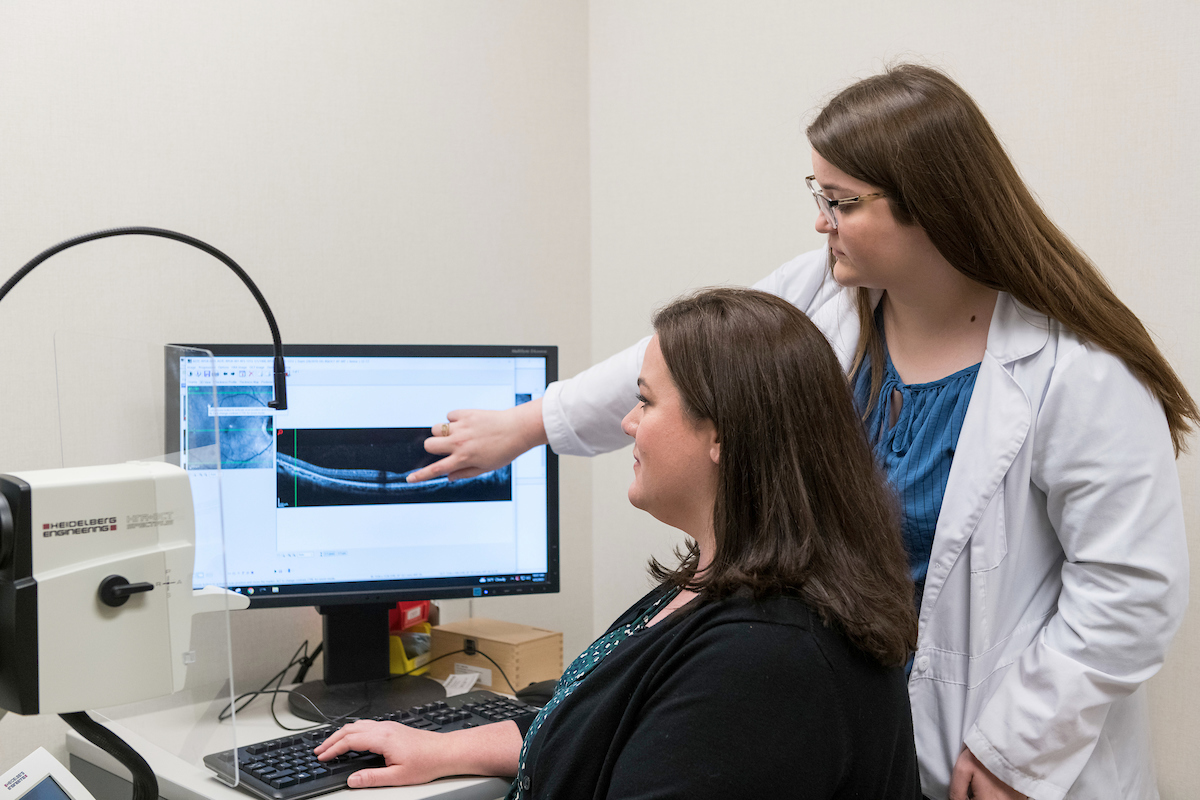
- Heidelberg OCT
- Zeiss Plex-Elite OCT-A
- Microperimetry (PRN)
The eye exams are non-invasive visual function exams. We will dilate both of your eyes in order to better examine your retina. Please bring sunglasses with you. If you do not have any, we will provide disposable sunglasses. We will take pictures of the back of your eye using non-invasive equipment designed to track the retina’s surface and inner layers.
Following the tests, you will visit with your doctor, who can provide insight on the tests and answer any questions.
Get expert help
Latest News
Age-Related Macular Degeneration Happenings at the Foundation
In-Depth Vision Evaluations & Research Updates for Retinal Diseases – Video Update
Treating AMD
Researching AMD
Understanding AMD
Researching AMD
AMD Clinical Studies We’re
Currently Enrolling For:
Get the Latest Updates
Sign up to receive the “Recently @Retina” newsletter to keep up-to-date.